Reddit SEO
 Wordpress
 WooCommerce
 Shopify
 Magento
 BigCommerce
 HubSpot
 Neto
Neto
 Headless
 ChatGPT
 Gemini
TL;DR
-
AI search is tiny in volume but sends the big orders: $700K of tracked AI revenue across 100 brands in 21 months, with high-consideration orders worth $900 to $2,500.
- It runs on the SEO foundations you already fund. AI visibility is not a separate discipline or a separate product.
- Fund fundamentals, content, and digital PR. Be skeptical of anyone selling a standalone "AI search product" on top of the SEO you already pay for.
Someone on your board asked what your AI search strategy is, and the room went quiet. Here is the honest answer: AI search is real, it is early, and the right response costs less than the hype is telling you.
You do not need a panic budget. You need to understand what the data actually shows, then make one or two clear decisions.
We pulled 21 months of data across 100 Australian ecommerce brands, July 2024 to March 2026, every channel. What follows is what that data says, not what a webinar is trying to sell you.
AI Search Is Tiny in Volume. It Also Sends Your Biggest Orders.
AI search drives very little traffic today. The traffic it does drive buys the expensive things.
Across 100 brands over 21 months, we tracked about $700,000 in revenue attributed directly to AI search, mostly ChatGPT, from roughly 340,000 sessions. As a slice of total revenue, that is a rounding error. If you reallocated your marketing budget around it tomorrow, you would be chasing the rounding error and starving everything that pays the bills.
But the volume is not the story. The value per visit is.
When someone arrives from ChatGPT, they tend to buy bigger. One retailer turned roughly 1,500 ChatGPT sessions into about $90,000 in revenue. That is over $60 per session, more than 20 times the Google organic average of around $2.65.
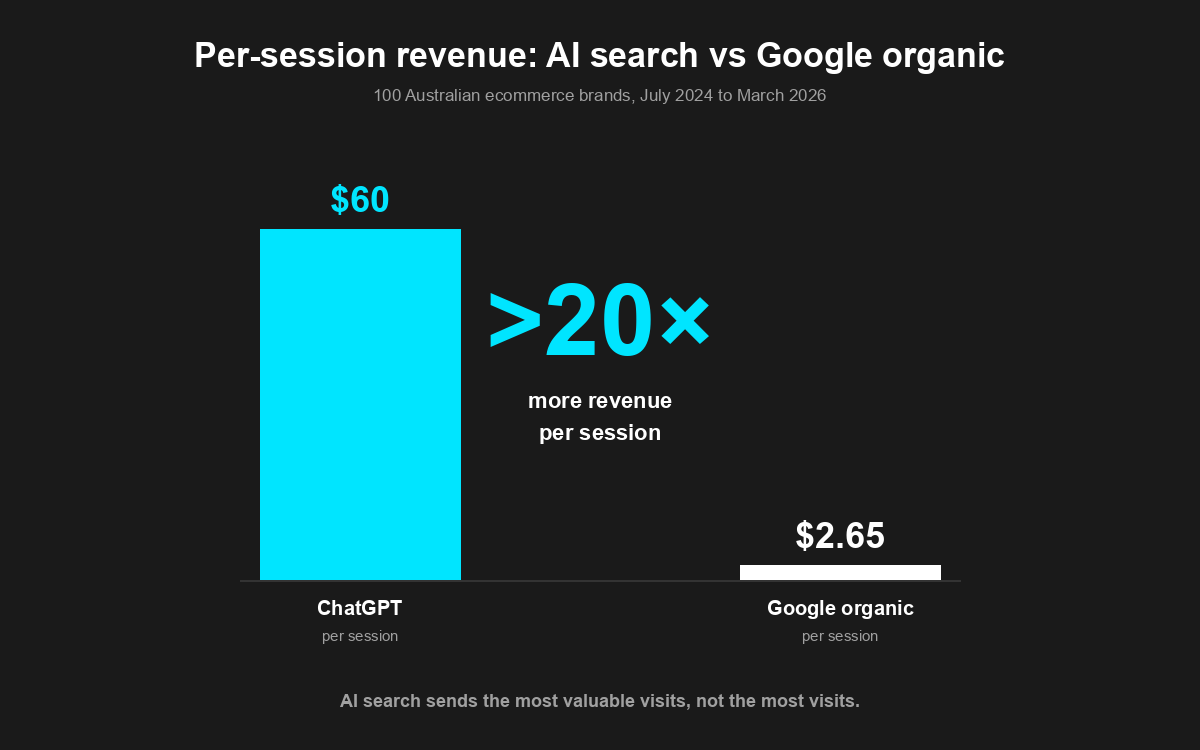
AI sends the most valuable visits, not the most visits.
The headline average hides it. ChatGPT's overall order value (around $220) barely beats Google organic (around $215). The outliers carry the story, and the outliers are expensive, high-consideration products. That is the pattern that matters for your board.
The High-Ticket Effect: Where AI Actually Sends Revenue
AI search concentrates in the categories where buyers research hard before they spend.
In our data, AI-referred orders in high-consideration categories were worth $900 to $2,500, far above the typical organic basket. The pattern is consistent: the bigger and more considered the purchase, the more AI search punches above its weight.
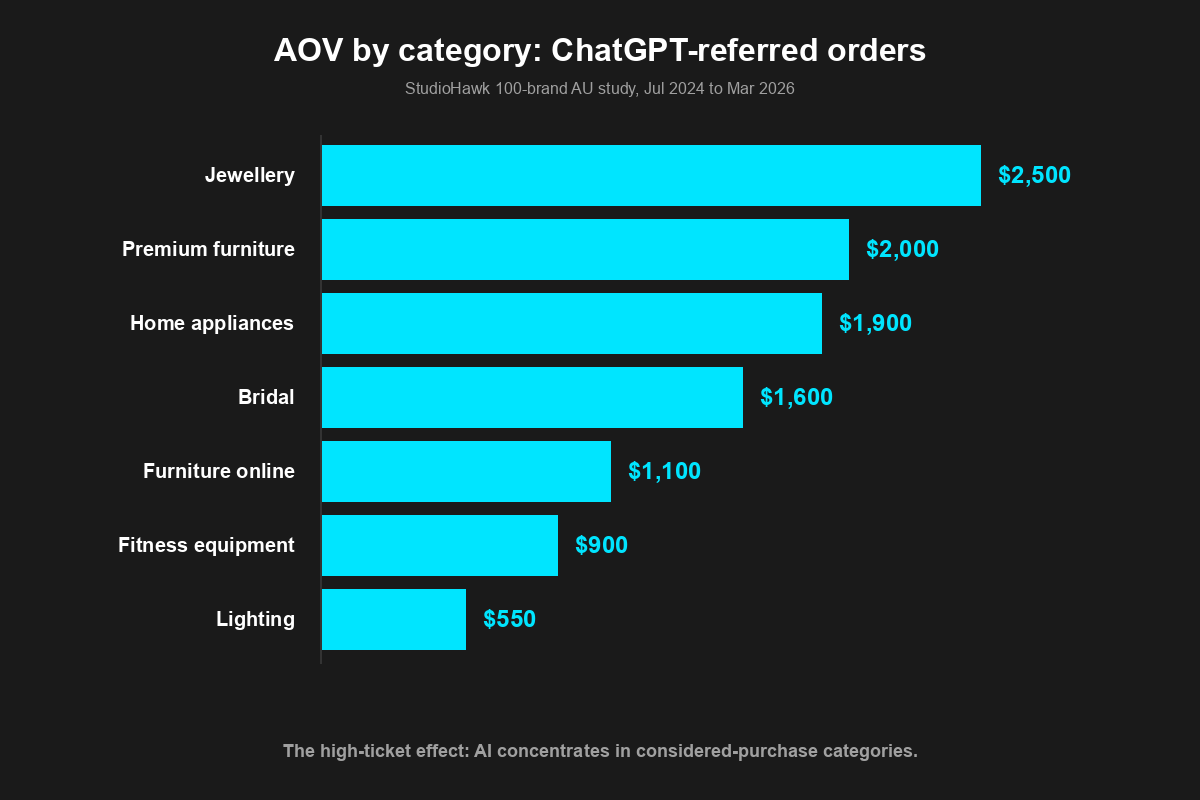
he high-ticket effect: AI concentrates in considered-purchase categories.
Here is why it happens. When someone types "what's the best sofa bed under $2,000 in Australia" into ChatGPT, they are near the end of their journey, not the start. The AI has already read the reviews, compared the specs, and weighed the price. The comparison shopping that normally happens across a dozen browser tabs has been done. For a high-ticket product, that compressed journey is a gift: the hardest part of selling a $2,000 item has been outsourced to the AI.
A high order value is not the same as a high conversion rate, and that is fine. Premium furniture converted at about 0.3% from ChatGPT, which is exactly what you expect from a considered purchase. Home appliances, a faster decision, converted at about 3.3%. Same high-ticket bucket, very different behaviour, both normal.
The lesson for a CMO is not "pour budget into AI search." It is "make sure that when AI sends a high-intent buyer, your page closes the sale."
It Runs on the SEO You Already Fund
The uncomfortable truth for the AI hype cycle: most of what wins AI search is the SEO work you are already funding.
AI tools do not have a secret, separate index. ChatGPT leans on Bing. Google's AI Overviews and AI Mode run on Google's own search results. When an AI system decides which brands to mention, it pulls from the same signals that decide who ranks: strong technical foundations, genuinely useful content, and authority across the web.
That means GEO, AEO, or whatever the acronym is this quarter, is a layer on top of SEO. It is not a new discipline, and it is definitely not a separate product.
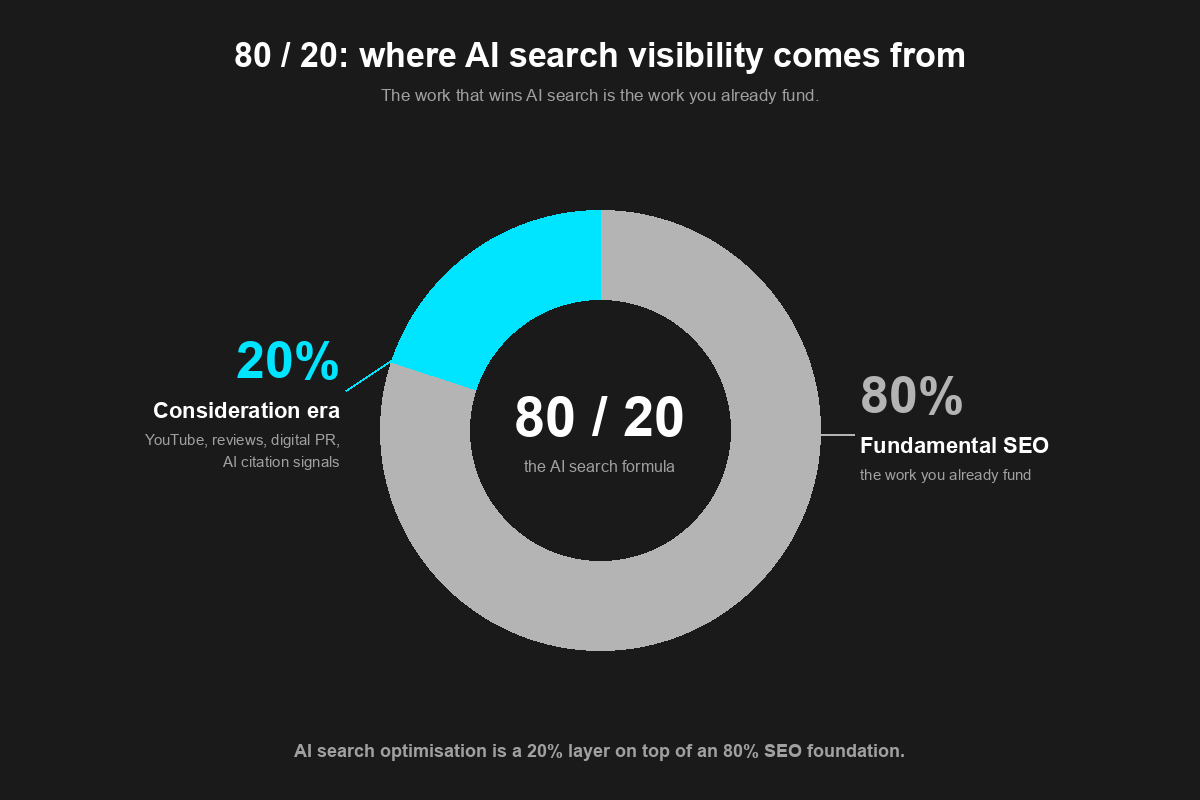
The work that wins AI search is the work you already fund.
The 20% on top is the consideration era work: showing up in the places AI models pull from when they make recommendations. That is YouTube, Reddit, Trustpilot and review platforms, podcasts, and earned media through digital PR. It matters, but it only works once the 80% underneath it is solid.
What the Winners Do (And a Real Example)
The brands capturing high-ticket AI orders are the ones whose product pages are built to inform, not just to sell.
When AI hands a buyer a shortlist, it favours pages it can actually read: clear product specs, visible pricing, structured data, and answers to the real questions a buyer asks. Thin pages that only exist to push "add to cart" do not give the AI enough to work with, and they do not close the high-intent visitor when the AI sends them.
When we implemented structured product markup across the catalogue for Hush Puppies, product page revenue rose 45%, users lifted 29%, and top-three positions grew 150%. That is the same work that makes a page legible to AI: structure it so both a buyer and a machine can extract what matters.
None of that is exotic AI tooling. It is product pages done properly, which is why it pays off in Google and AI search at the same time.
Where to Put the Money (And What to Stop Funding)
If you make one decision after reading this, make it a budget decision: fund the foundations, and refuse the panic upsell.
The market is filling with vendors selling a standalone "AI search" or "GEO" retainer on top of the SEO you already pay for. In most cases they are charging you twice for overlapping work. Before you sign anything, ask them to show a measurable outcome. If they cannot, that is your answer.
| Fund this | Be skeptical of |
| Technical foundations | A seperate "GEO" or "AI search" product on top of existing SEO |
| Product pages built to inform, not just sell | Tools that promise to trick or game AI |
| Digital PR & brand authority | Anything with no measurable outcome |
| Proper measurement (GA4 AI Assistant channel grouping, Search Console) | Panic spend driven by one board meeting |
Owned search is still the asset that compounds. Paid ads are rented traffic, and that rent goes up every year. The brands that invest in owned visibility now are the ones AI will be recommending in two years, for a fraction of the ongoing cost.
None of this requires a new line item. It requires making sure the line items you already have are actually strong.
Four Questions to Ask Your Team This Quarter
You do not need to do the work. You need to ask four questions and listen carefully to the answers.
-
Are we even measuring AI search traffic? GA4 now has an AI Assistant channel grouping, so ChatGPT, Gemini, and Claude referrals get bucketed automatically. If your team cannot show you that number, you are blind on the channel everyone is asking about.
- Are our high-ticket product pages built to close? For your most considered, highest-value products, do the pages have visible pricing, structured specs, and answers to real buyer questions? That is what converts the high-intent visitor AI sends.
- When buyers ask AI about our category, do we show up? Ask your team to run the real questions your customers ask ChatGPT, Perplexity, and Gemini, and report back honestly on whether you appear, and which competitors appear instead.
- Is anyone trying to sell us a separate AI search product? And if so, can they prove a measurable outcome? The honest vendors will welcome the question.
If your team can answer these four clearly, you are ahead of most boards asking the same question this quarter.
The Bottom Line for the Boardroom
AI search is tiny in volume today, but it sends disproportionately large, high-consideration orders, and it runs on the SEO foundations you already fund. The brands winning it have product pages built to inform and authority earned across the web. So fund the fundamentals, sharpen your high-ticket pages, measure properly, and be skeptical of anyone selling a panic-priced AI search product on the side.
That is the honest answer for your board. Calm, specific, and a lot cheaper than the alternative.
If you want a clear read on where your brand actually sits in AI search and what to fund next, you can request an SEO & AI Masterplan. And if your team wants to skill up for free, send them to Hawk Academy.
FAQ
What is AI search and how is it different from SEO?
AI search is when tools like ChatGPT, Perplexity, Google AI Overviews, and Gemini answer a query directly and cite or recommend brands, rather than returning a list of blue links. It is not separate from SEO. These tools pull from the same search indexes and ranking signals, so strong SEO is what gets you cited.
Do we need a separate AI search or GEO strategy?
For most brands, no. GEO, AEO, and AI search optimisation are a layer on top of solid SEO, not a separate discipline. The smarter move is to strengthen your fundamentals and add consideration era work like digital PR, rather than paying for a standalone product that overlaps with your existing SEO.
How much revenue does AI search actually drive right now?
In our 100-brand AI search study across 21 months, AI search drove about $700,000 in directly attributed revenue. Tiny in volume, but it skews toward expensive, high-consideration orders worth $900 to $2,500, so the value per session is roughly 20 times Google organic.
How do we measure AI search traffic?
GA4 now includes an AI Assistant default channel grouping, so ChatGPT, Gemini, and Claude referrals are bucketed automatically. Combined with Search Console, you can track AI-referred sessions and the pages that earn them without custom filters.
Should we cut our SEO budget to fund AI search?
No. AI visibility depends on the same foundations as organic search, so cutting SEO to chase AI search undermines both. Fund the fundamentals first, then layer on the consideration era work that helps AI systems find and trust you.