Reddit SEO
 Wordpress
 WooCommerce
 Shopify
 Magento
 BigCommerce
 HubSpot
 Neto
Neto
 Headless
 ChatGPT
 Gemini
TL;DR
Google Search Console launched platform properties on 7 July 2026. For the first time you can see the clicks, impressions, queries and positions your YouTube, TikTok, Instagram and X content earns in Google Search and Discover.
That data makes a social topical map possible: a view of which topics your social content already ranks for on each platform, so you can act on it instead of guessing.
We plugged in our own YouTube channel as the worked example. Two days of data showed 303 page-one Google rankings we could never see before. Here is the method we use to turn that into clicks, and it works the same for any social platform. You can find what we cover here:
- You Can Finally See How Your Social Content Ranks on Google
- What Platform Properties Actually Show You
- What We Saw When We Plugged In Our Own Channel
- The Bigger Idea: A Social Topical Map Per Platform
- The Method: Optimise, Embed & Produce
- What The Map Compounds To
- What This Means for Brands
- FAQs
You Can Finally See How Your Social Content Ranks on Google
For years, ranking your social content on Google was a black box. You posted to YouTube, TikTok, Instagram or X, the content sometimes showed up in a Google search result, and you had no idea which searches, how often, or where you sat. The native analytics told you about the platform. They told you nothing about Google.
That changed on 7 July 2026. Google Search Console launched platform properties, a new property type that shows how your social and video content performs in Google Search and Discover. You verify a YouTube, TikTok, Instagram or X account, and you get the same Performance report you already get for a website: clicks, impressions, queries, and average position.
This is the missing measurement layer for social content. And it unlocks something bigger: a social topical map for each platform.
We are going to use our own YouTube channel as the worked example through this piece, because that is where we have the richest two days of data. The method is platform-agnostic. The same three moves apply whether you are ranking long-form video, Shorts, Reels, TikToks or posts on X.
What Platform Properties Actually Show You
A platform property gives you three reports.
The Performance report is the important one. Total clicks and impressions, filterable by query and by individual post, with average position. This is the exact same report you get for a website property, pointed at your social channel instead.
The Insights report is a plain-language overview: recent traffic trends, top-performing posts, how people find your account on Google.
Achievements track milestones, like passing a click threshold in the last 28 days.
Setup takes two minutes. Open Search Console, add a property, pick Instagram, TikTok, X or YouTube, and follow the verification steps. Google is rolling this out gradually over the weeks following launch, so it may not appear in your account immediately. This is separate from Search profiles, the public creator pages Google introduced in June. Platform properties are analytics, not a public page.
What We Saw When We Plugged In Our Own Channel
We verified our YouTube channel the day the feature appeared. Here is the honest picture from the first two days of data, because real numbers beat invented ones.
Across those two days, our videos earned 35,585 impressions and 7 clicks in Google Search, at an average position of 25. A 0.02 percent click-through rate.
On the surface that looks bad. Seven clicks. But average position 25 is the reason: most of our videos sit on page two or three of Google, where almost nobody clicks. The clicks are not the story. The impressions are.
Because underneath that headline number, the query data showed something we had never been able to see. Our videos surfaced in Google for 1,005 different search queries. And 303 of those queries put a video on page one of Google. Three hundred and three page-one rankings for video content, completely invisible to us until the day this feature launched.
That is a topical map. It just needed a way to be seen.
The Bigger Idea: A Social Topical Map Per platform
Here is the concept. Every social account builds a topical footprint on Google, whether it means to or not. The content you publish gets associated with topics, and Google surfaces it for searches related to those topics. Until now that footprint was invisible. Platform properties make it visible, per platform, for the first time.
Once you can see it, you can shape it. That is the social topical map: the set of topics your social content already ranks for on a given platform, treated as a map you deliberately expand and optimise rather than a byproduct you ignore.
Our channel's map came through clearly in the query data. Three clusters dominated.
A sitemaps cluster: 36 query variants, led by "what is a sitemap" sitting at position 4.09 with 727 impressions. A keyword research cluster, led by the query "keyword research" at position 10.6 with 2,617 impressions, the single biggest impression opportunity on the channel. And a large enterprise SEO cluster: 164 query variants covering everything from "enterprise seo strategy" to "enterprise seo agency".
None of that was planned as a Google strategy. It emerged from publishing video about the things we know. The map was always there. We just could not read it until now.
The Method: Optimise, Embed & Produce
A map is only useful if you act on it. We run every platform property through three moves. Optimise, embed, produce.
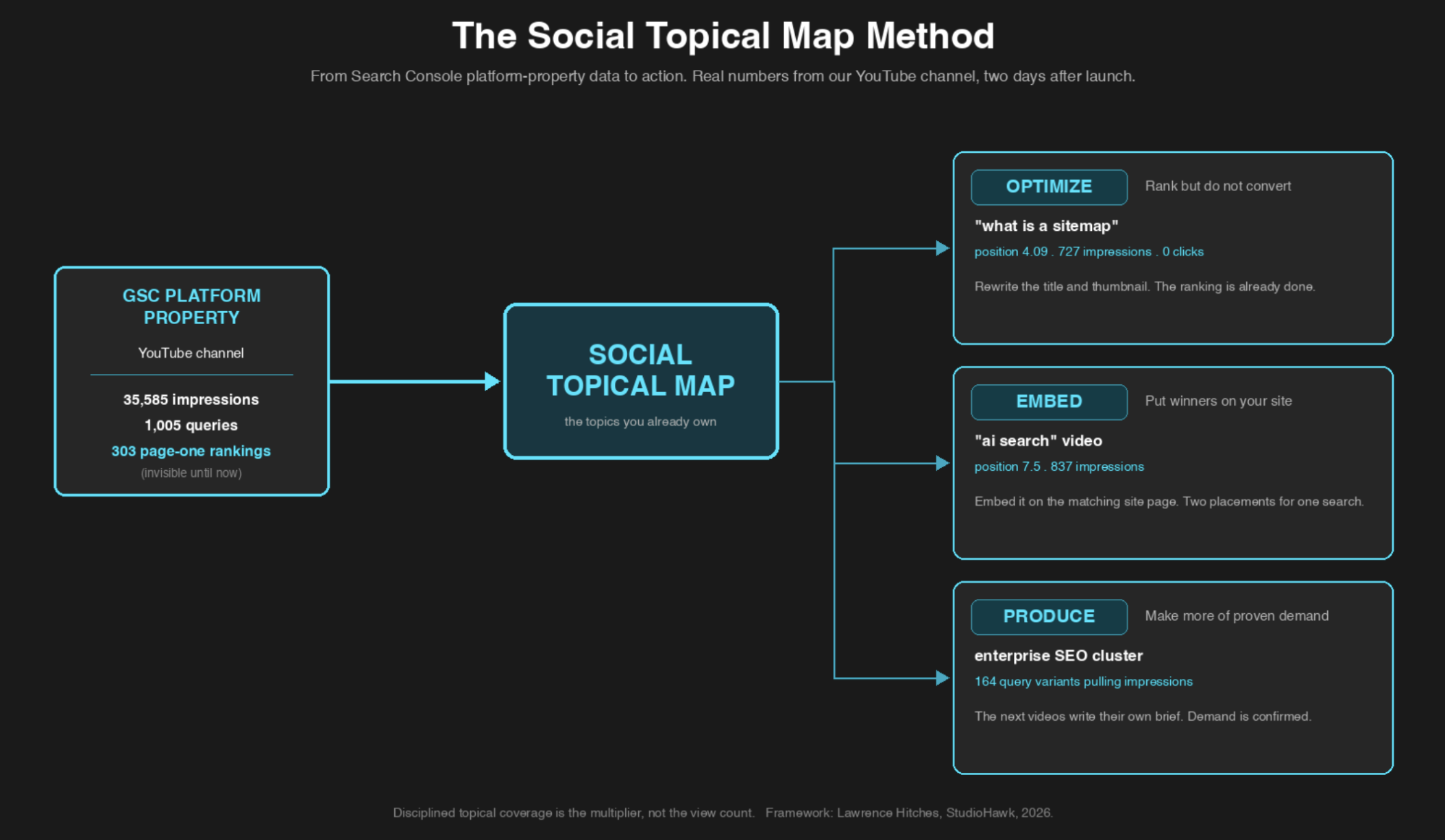
The method mapped to real channel data. Framework: Lawrence Hitches, StudioHawk, 2026.
Optimise The Videos That Rank but Do Not Convert
The fastest wins are videos already ranking on page one that are not earning the click. The ranking is done. The title and thumbnail are the problem.
Our clearest example: "what is a sitemap" at position 4.09, with 727 impressions and zero clicks. A video ranking fourth on Google for a real query, earning nothing, because the title and thumbnail were built for YouTube browse, not for a Google searcher asking a direct question. That is a title and thumbnail rewrite, not a new video. The impressions are already there.
The bigger version is "keyword research": 2,617 impressions at position 10.6, right on the edge of page one. Push that from the bottom of page one to the top and the impressions convert to real, recurring clicks.
Embed The Winners on Your Website
The second move: take the videos ranking well on Google and embed them on the matching pages of your own site. A video ranking at position 7.5 for "ai search" belongs embedded on your AI search page. It compounds the authority of both assets and gives you two placements in the results for one search instead of one.
This is where a social topical map connects back to your website topical map. The platforms and the site stop being separate channels and start reinforcing each other.
Produce Against Proven Demand
The third move: the clusters tell you what to make next. Our enterprise SEO cluster showed 164 query variants already pulling impressions. That is not a hypothesis about what might work. It is demand the data has already confirmed. The next videos write their own brief.
This is the opposite of chasing virality. Popularity does not select the topic. The topical map does. Off-topic viral content actually hurts, because it pollutes how the platform classifies your channel. Disciplined topical coverage is the multiplier, not the view count.
What The Map Compounds To
Here is the part that matters. Position 25 and a 0.02 percent click-through rate look like a dead channel. They are the opposite. That CTR is a floor set by the position, not a ceiling set by the content. The impressions are already there. When you lift the positions and fix the titles, the clicks do not grow in a line. They compound, because two things move at once: the impressions grow as you produce and embed, and the click-through rate normalises as buried videos climb toward page one.
We modelled it off the two-day run-rate. This is a projection, not a measured result, and it assumes the map gets actively worked. We are publishing it so we can report back against it.
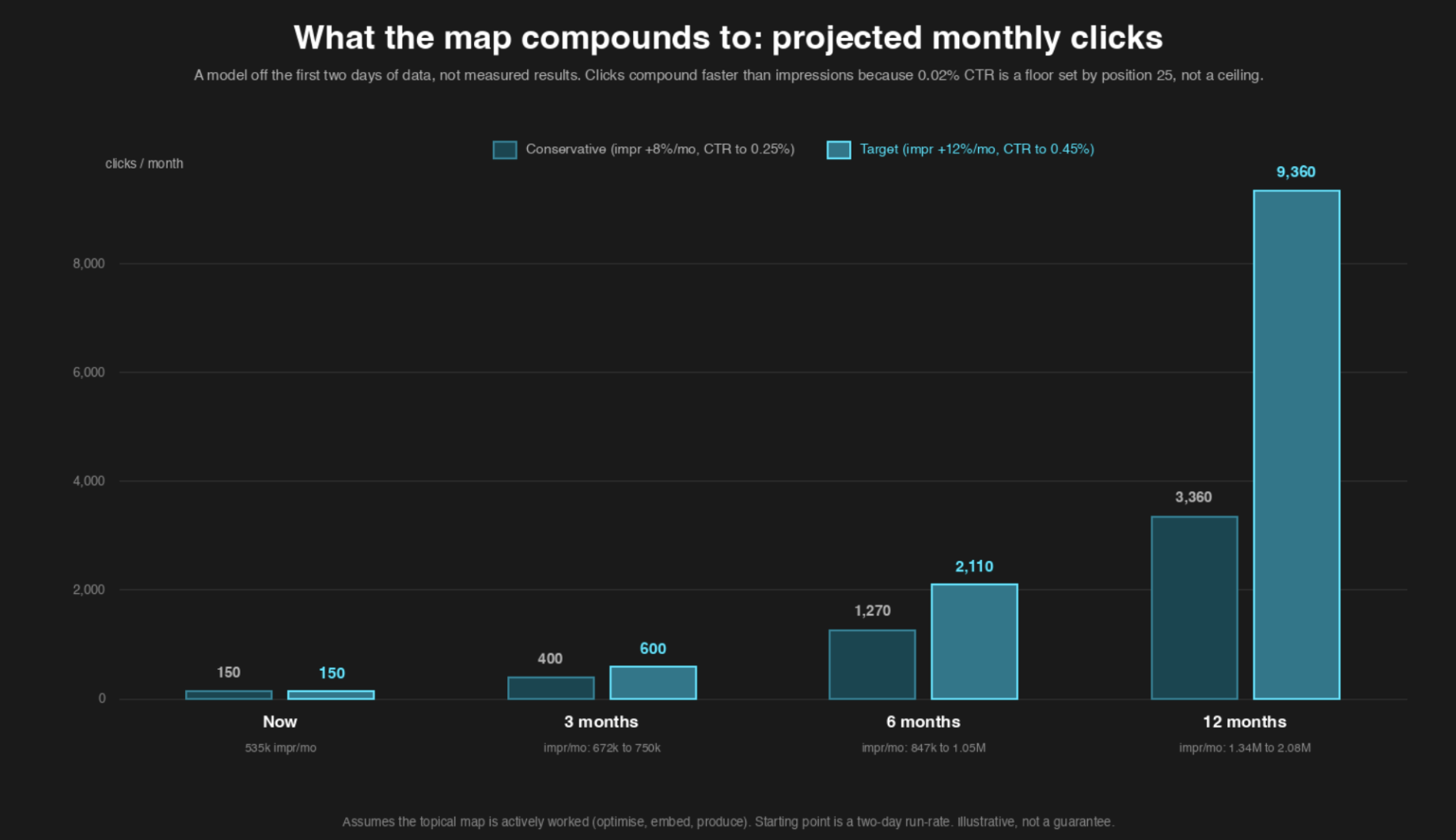
A model off the first two days of data. Clicks compound faster than impressions because the 0.02 percent CTR is a floor set by position 25. Illustrative, not a guarantee.
The run-rate today is about 535,000 impressions a month and, call it, five clicks a day. Roughly 150 clicks a month. Hold two levers and watch what happens.
Conservative case. Impressions grow 8 percent month on month as we embed winners and produce against proven clusters. Blended CTR climbs from 0.03 percent toward 0.25 percent as the highest-impression videos move up the page. At three months that is roughly 400 clicks a month, at six months about 1,270, and at twelve months around 3,360. More than a twenty-fold increase, driven almost entirely by converting impressions that already exist.
Target case. Impressions grow 12 percent month on month and blended CTR reaches 0.45 percent, which is still modest for a channel already holding 303 page-one rankings. That is roughly 600 clicks a month at three months, 2,100 at six, and about 9,360 at twelve.
The gap between the two cases is not luck. It is how hard the map gets worked. Neither case requires a single viral video. Both are the arithmetic of moving buried content up a results page and letting a click-through rate that started near zero return to normal.
What This Means for Brands
Three things change now that this data exists:
-
Social video becomes a measurable search channel, not a vanity metric. You can put a number on how your TikTok, Instagram, YouTube and X content performs in Google, and report it alongside your website.
-
The line between social and SEO gets thinner. If your video content ranks in Google, it is subject to the same optimisation logic as a web page. Title, thumbnail, topical relevance, and the query behind the impression all matter.
- The brands that map their footprint early get a head start. The evergreen advice on ranking video in Google predates this feature and stops at "add video schema and good thumbnails". That advice is not wrong, but it has no measurement layer and no method. The social topical map is the method, and platform properties are the data that finally makes it run.
We built the social topical map framework before this data existed, running it on the platform-property export while it was still a Google experiment. Now that the export is an official feature covering four platforms, the method has its data source in the open. If you want the framework in full, our Chief of Staff Lawrence Hitches has published it in depth on his site.
FAQ
What are Google Search Console platform properties?
A property type Google launched on 7 July 2026 that shows how your social and video content performs in Google Search and Discover. You verify a YouTube, TikTok, Instagram or X account and get clicks, impressions, queries and average position, the same Performance report a website property gets. They are analytics, distinct from Search profiles, which are public creator pages.
Can you really rank a social video in Google search?
Yes. Google surfaces YouTube videos and other social content in search results and Discover. Our own channel surfaced for 1,005 queries in two days, with 303 of them on page one. The question was never whether video ranks in Google. It was whether you could measure it, and now you can.
How is this different from YouTube Studio analytics?
YouTube Studio shows performance inside YouTube. Platform properties show performance in Google Search. A video can do modestly on YouTube and still earn thousands of Google impressions for a query YouTube analytics never mentions. They are two different discovery surfaces, and until now you could only see one of them.
What is a social topical map?
The set of topics your video content already ranks for on a given platform, treated as a deliberate map you expand and optimise rather than an accident you ignore. Platform properties make the map visible. The method is to optimise videos that rank but do not convert, embed winners on your website, and produce more content against the clusters the data proves have demand.
Which platforms does this support?
At launch, four: Instagram, TikTok, X and YouTube. Google has said more may follow. The rollout is gradual over the weeks after 7 July 2026, so the option may not appear in your account immediately.
Do I need a website to use platform properties?
No. One of the reasons Google built this is to give creators without their own website a way to see how their content is discovered in Search. That said, the biggest gains come from connecting the social topical map back to a website, through the embed move above.