Reddit SEO
 Wordpress
 WooCommerce
 Shopify
 Magento
 BigCommerce
 HubSpot
 Neto
Neto
 Headless
 ChatGPT
 Gemini
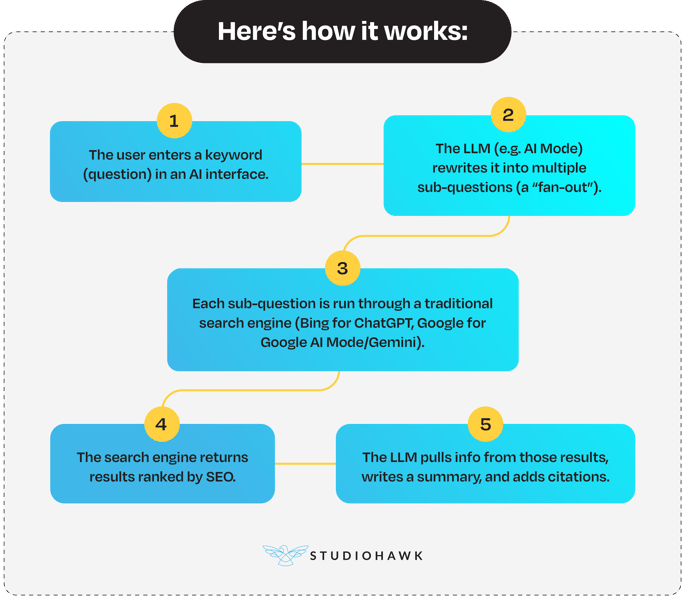
When someone types a question into Google AI Mode, they see one answer. Behind the scenes, Google fires off 8 to 12 hidden sub-queries before generating that response, each one pulling from a different source.
That process is called query fan-out. And if your SEO strategy is built around ranking for one primary keyword, you are invisible for most of it.
This article explains how fan-out queries work, why they matter for your organic visibility, and what you can do right now to ensure your content gets pulled into those hidden retrieval requests. Here is what we'll cover:
- What Is Query Fan-Out?
- Why Your Rankings Are Not Protecting You
- The Zero-Click Reality
- How to Map Out Your Content to Fan-Out Queries
- The One Content Mistake That Kills Fan-Out Visibility
- The Bigger Picture
What Is Query Fan-Out?
Query fan-out is how AI search systems decompose a single user question into multiple smaller, more specific sub-queries. Instead of searching once, the system searches dozens of times, gathering fragments of evidence from different sources before synthesising a final answer.
A user asking "What is the best EV charger for a BYD Atto 3 in Australia?" might trigger sub-queries like:
-
"BYD Atto 3 charging specifications"
-
"Type 2 vs CHAdeMO EV chargers Australia"
-
"Home EV charger installation cost Australia"
-
"Best home EV chargers 2026 review"
-
"EV charger rebates Victoria 2026"
Each sub-query retrieves from a different source. Each source has a chance to be cited. None of them are the original question.
Peec AI's analysis of over 10 million prompts found ChatGPT generated more than 20 million background fan-out queries, meaning the system fires off multiple retrieval requests behind every single search. The average fan-out query is also significantly longer and more specific than a typical Google search, which is why pages you would never rank for traditionally can still be pulled into an AI answer.
This is a structural change to how search works. Google's own documentation on AI features in search confirms that AI systems are designed to synthesise answers from multiple sources, not just surface the highest-ranking page.
Why Your Rankings Are Not Protecting You
Traditional SEO rankings give you a false sense of security in the age of AI search.
Ahrefs' analysis of 863,000 keywords found that only 38% of pages cited in AI Overviews rank in Google's top 10, and that figure has dropped sharply, down from 76% in mid-2025. The majority of AI citations are going to pages that traditional SEO alone would never surface.
The reason is fan-out. AI systems are not retrieving answers to the user's original question. They are retrieving answers to the subquestions they generate internally. A page that ranks for "EV charger installation" might not rank for "EV charger rebates Victoria 2026", but it could still be cited for the latter if it covers the topic with sufficient depth and specificity.
Traditional SEO gets you to the door. Fan-out coverage gets you inside.
As our founder Harry Sanders puts it, "Google feels more like a consultant who hands you the answer and then tells you where to go." You must be the source for all the component questions, not just the headline one.
As we cover in our guide to ranking in Google's AI Mode, the game has shifted from earning a ranking to earning a citation. Fan-out is the mechanism that makes that shift concrete.
The Zero-Click Reality
Before discussing what to do, we must accept a harder truth.
A Pew Research study of 68,000 real search queries found that users clicked only 8% of the time when an AI summary appeared, compared to 15% when they saw standard results. Zero-click searches have risen from 56% to 69% of all searches between May 2024 and May 2025, according to Similarweb.
Zero clicks do not mean zero value. Citations in AI summaries present your brand to high-intent users precisely when they are making a decision.
Harry Sanders made this point directly on theDain Walker Agency Podcast: "Purely informational queries no longer drive traffic since AI overviews answer them directly. Commercial and transactional intent now matters most for businesses." The goal is to dominate the commercial and comparison queries where AI citations still convert, not to chase informational traffic.
The data supports this. Search Engine Land reports that Google AI Mode sends traffic on 69% of transactional queries, meaning when users are ready to buy or book, AI search still pushes them to websites.
When your content is cited in an AI Overview or AI Mode response, you are also building brand recognition at the moment of intent. The user may not click today, but they see your brand name attached to the answer. That signal compounds. Brand search volume is the strongest predictor of LLM citations, outweighing the impact of traditional backlinks.
Treating AI citation as a purely traffic-based metric misses a significant part of its value.
Watch Harry explain this shift on Instagram:
How to Map Your Content to Fan-Out Queries
The practical question is: how do you build content that gets pulled into subqueries you cannot see?
Step 1: Identify the sub-questions around your core topics
For each major topic your business covers, map the specific subquestions a thorough AI system would need to answer before it could address the broader topic. Think in terms of specifications, comparisons, process steps, costs, timelines, and local context.
Two tools are particularly useful here. The first is Google Search Console: filter your queries report for question-format searches (who, what, how, why, best, vs), and you will often find fan-out sub-queries already surfacing in your impressions data, even where you are not yet ranking.
The second is SEOgets, which connects to your GSC account and removes the standard 1,000-row data limit, letting you analyse up to 5,000 pages and cluster queries by topic with one click.
Together they give you a clear picture of the sub-query landscape around any topic you own.
Google's "People Also Ask" boxes and Ahrefs' related questions feature round out the research.
Step 2: Map sub-queries to specific content assets
Each sub-query needs its own focused answer. That does not mean a separate blog post for every variation. It means your content architecture covers the topic cluster with enough specificity that multiple subquestions resolve to your pages.
As Harry Sanders has noted, the key is topical ownership: "The riches are in the niches — what can you own that someone else isn't going to go after?" Fan-out coverage rewards exactly that. Go deep on a specific topic cluster and you cover more sub-queries than a competitor with broad, shallow content.
Step 3: Format for extraction, not just reading
AI systems extract short, coherent passages rather than long, flowing articles. The structure and formatting of your content matters as much as the words.
In practice:
- Use H2 and H3 headings that mirror how sub-queries are actually phrased
- Write answer-first paragraphs: state the key fact in the first sentence, then expand
- Use structured lists and tables for comparison content
- Put the answer first, never buried in context
Our guide to implementing Article and FAQ schema for AI search covers the technical markup that reinforces this structure for AI crawlers. And if you want to go deeper on the writing side, how to write content for AI Mode walks through the content layer in detail.
Step 4: Build topical coverage across your cluster, not just your pillar
One high-quality pillar page is not enough. AI fan-out pulls from multiple sources across multiple distinct pages, not one long guide.
Harry Sanders on this: "If one keyword is moving around, don't look at those. Look at the overall topic and optimise for that." Topic-level coverage, not keyword-level targeting, is the right frame.
The One Content Mistake That Kills Fan-Out Visibility
There is a temptation, especially with AI writing tools now everywhere, to publish volume. More pages, more keywords, more content.
Harry Sanders is direct about this: "Mass-producing low-quality AI content dilutes crawl budget and topical authority. Focus on quality over quantity, fewer, better pages outperform thousands of mediocre ones."
The fan-out model requires breadth, specifically high-quality answers instead of thin coverage.
A cluster of 10 well-researched, tightly formatted pages will out-cite a site with 200 shallow ones every time.
AI can only cite content that exists and has earned enough trust to be retrieved. Volume without quality gets you neither.
The Bigger Picture
Fan-out queries are the mechanism behind what StudioHawk calls AI SEO or AI Search. You will see other terms for it (GEO, AEO, and a handful of others), but they all describe the same shift: optimising it to be retrieved and cited by AI systems rather than just ranked by algorithms.
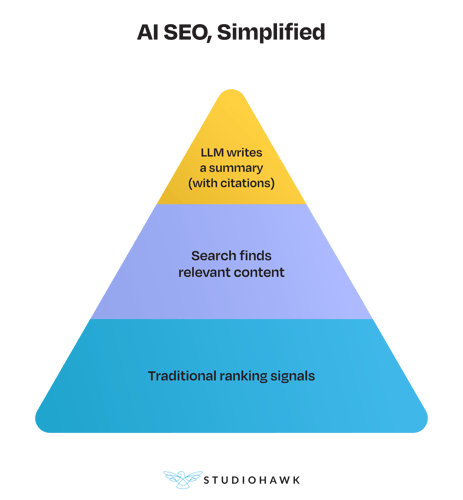
Every subquery the system generates is an opportunity to be the cited source. Miss those sub-queries and you are invisible in the part of the search that is growing fastest.
The brands that dominate AI search in 2026 will not be the ones with the highest domain authority. They will be the ones whose content architecture covers the most specific, extractable answers across the most relevant subtopics.
Fan-out is the new content strategy. Build for it accordingly.
Optimising for fan-out queries takes a different playbook than classic keyword SEO. Our AI SEO team builds strategies designed for how AI actually searches.
And for a full picture of where AI search is heading this year, see our SEO and AI Search 2026 Trends and Predictions.